
Latest insights

Salary sacrifice vs personal contract hire vs personal contract purchase
How do I calculate my salary sacrifice car budget?

Electric
The government’s decision to implement the ban on new cars that use an internal combustion engine (ICE) by 2035 means that electric vehicles (EVs) are never far from the news.
There’s now a much wider choice of EVs for you to choose from for your next brand-new car. There’s also a range of home charging options to look at too, whether you own or rent your home and whether you park it on public roads or not.
New-build houses with associated parking spaces are obliged to include an EV charging point and grants are available to help with the cost of installing different kinds of chargers, depending on your eligibility.
We’re here to help you explore which of these chargers is the best option for you, if you drive an EV and are interested in home charging.
It’s possible to charge your new EV with a standard three-pin plug, but it’s a long process. Wall-mounted charge boxes offer a much greater degree of usability and efficiency to drivers with off-road parking at home.
Wall boxes come in a range of capacities and incentives for the user. From a simple 3.6kW charger to more powerful devices that can use solar energy, you’re sure to find the right one to fit your requirements.
Before you begin the process of installing your wall box charger, you’ll need to conduct a site survey to make sure your choice of charger is compatible with your house. Many wall box installers can offer this service as part of a package.
Once you’ve received your home point charger from your supplier, you can arrange for an installer to drill through the exterior wall and connect the box to the mains.
Remember, if you’re renting, you will need to seek your landlord’s permission before installing the charger. In fact, your landlord can apply for a grant to cover up to 75% of the cost of purchasing and installing a charge point, up to the value of £350.

3.6kW charger
7kW charger
22kW charger
When selecting your charger, you’ll have the option of tethered or untethered.
| Tethered | Untethered |
|---|---|
| Uses cables which are hard-wired into the wall box. | A cable that can be connected to a charger, either at your home or in a car park, and then disconnected to be used at another charging location. |
| Having a built-in cable can make things easier – you don’t need to get the cable from your garage or car boot. Simply drive up and plug in. | You’ll need to remember your cable to be able to charge. |
| There’s no risk of forgetting your cable or losing it. | There’s no cable to tidy away on your driveway, but the cable will require storing. |
| If you need any maintenance, your cable will need to be repaired. | Untethered chargers offer more flexibility as you’ll be able to use your cable elsewhere. |
| As the cable is connected, you’ll need to tidy it away when you’re finished using it. | Untethered cables can be upgraded or switched if you get a new EV that requires a different cable or want to purchase a longer cable. |
| Tethered chargers can be more secure, as the cable cannot easily be removed and stolen. |
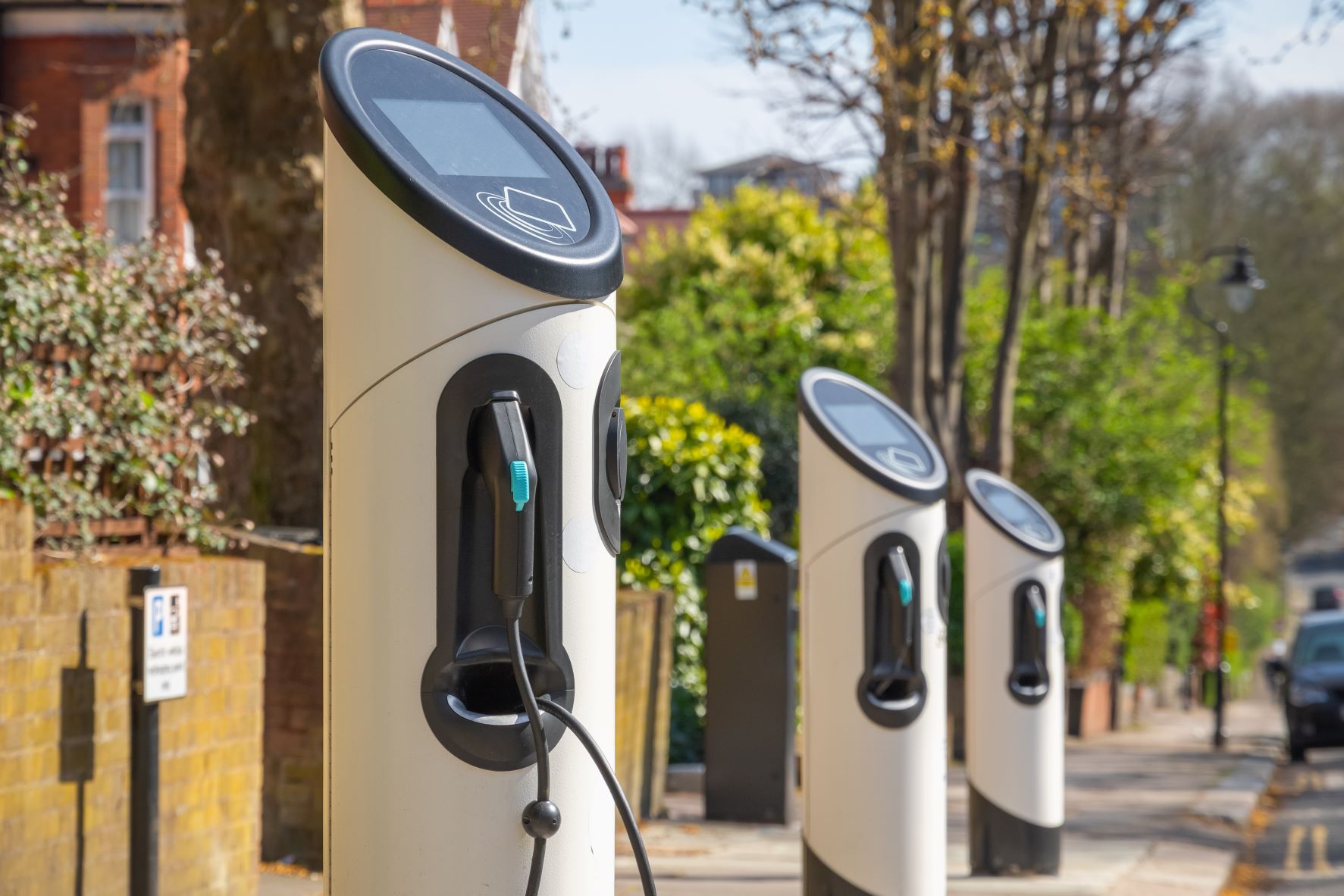
Wall boxes are a great resource for people who have access to off-road parking, however this excludes a significant proportion of drivers in this country.
This is where the On-street Residential Charging Scheme (ORCS) comes in.
It works by adding charging points to street furniture, such as lampposts. This drives down the cost of installing them because the groundwork isn’t as intrusive as it would be if the road had to be dug up.
The work is paid for by local authorities. Over 200 have taken up government funding to install an ORCS, with EV owners then given a smart lead that monitors their usage. The driver pays for their charging to the same local authority.
Similarly, trials are also underway to look at the viability of chargers that ‘pop-up’ from the road and plug into the car.